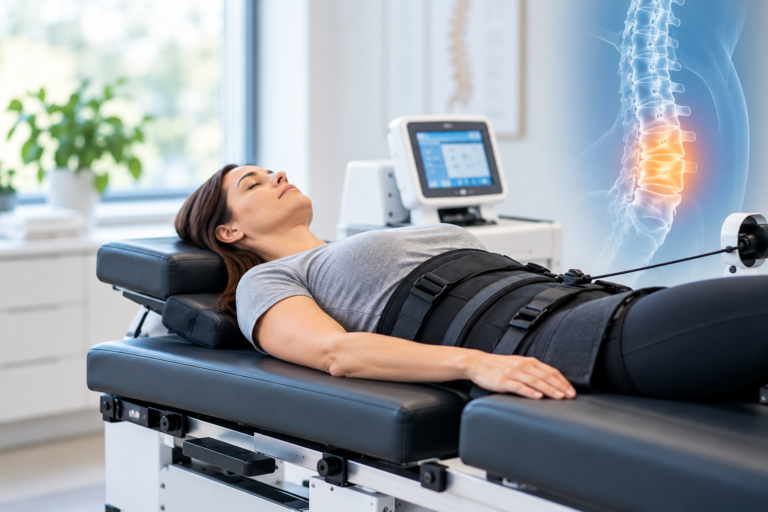
Non-surgical spinal decompression therapy uses controlled traction to gently stretch parts of the spine and reduce loading on spinal discs and nerve roots.
At Serene Healing Chiropractic, Triton DTS® Decompression Traction System can be used for the cervical or lumbar spine as part of a conservative treatment plan for selected patients with disc-related or nerve-related symptoms.
The goal is not simply to “stretch the back.” Treatment is carefully positioned and controlled based on the area involved, the patient’s symptoms, and the findings from the clinical evaluation.
What Is Non-Surgical Spinal Decompression Therapy?
Non-surgical spinal decompression is a form of mechanical traction.
The patient lies on a specialized treatment table while the system applies controlled pulling forces to the cervical or lumbar spine.
These forces alternate between periods of traction and relaxation. The goal is to temporarily reduce mechanical pressure on spinal structures while allowing the patient to remain comfortable throughout treatment.
Unlike surgical spinal decompression, this therapy does not involve incisions, anesthesia, or removal of bone or disc material.
How Does Spinal Decompression Work?
The Triton DTS system applies precisely controlled traction to the spine.
Depending on the area being treated, the patient is positioned so the traction force is directed toward the cervical or lumbar region.
The gentle pulling pattern can help:
- reduce loading on intervertebral discs
- reduce pressure around irritated nerve roots
- improve movement in restricted spinal segments
- temporarily relieve mechanical stress associated with certain disc conditions
Treatment involves repeated cycles of gentle traction and relaxation rather than one continuous strong pull.
This distinction is important because spinal decompression is intended to be controlled and individualized, not forceful.
What Conditions May Be Considered for Spinal Decompression?
Spinal decompression therapy may be considered when symptoms appear to be related to disc problems or nerve root irritation.
Common examples include:
- cervical radiculopathy
- lumbar radiculopathy
- bulging discs
- herniated discs
- sciatica
- radiating arm pain
- radiating leg pain
- disc-related neck pain
- disc-related low back pain
- numbness or tingling associated with nerve root irritation
- weakness associated with nerve compression
Whether decompression is appropriate depends on the actual cause of the symptoms.
Two people can both have leg pain or numbness and require completely different treatment plans.
Spinal Decompression for Lumbar Radiculopathy
Lumbar radiculopathy occurs when a nerve root in the lower spine becomes irritated or compressed.
Symptoms may include low back pain along with:
- shooting leg pain
- numbness
- tingling
- burning sensations
- weakness in part of the leg or foot
Disc herniation is one possible cause.
Research suggests non-surgical decompression may have a role for selected patients with lumbar radiculopathy. In one randomized controlled trial, adding non-surgical spinal decompression to routine physical therapy produced greater improvements in pain, disability, lumbar movement, and several functional measures than physical therapy alone after four weeks.
This does not mean every case of lumbar radiculopathy will respond the same way.
The source of the nerve irritation and severity of neurological symptoms still matter.
Can Spinal Decompression Help a Herniated or Bulging Disc?
A bulging or herniated disc can place mechanical stress on nearby spinal structures and, in some cases, irritate a nerve root.
Traction-based treatment may be considered as part of conservative management when the clinical picture supports it.
A 2025 systematic review and meta-analysis examining conservative treatment for lumbar disc herniation found improvements across exercise, manipulation, and traction therapies. Traction showed favorable pooled results, although the researchers also found substantial variation between studies.
That means spinal decompression should not be presented as a guaranteed way to “put a disc back in place.”
A better way to think about it is as one conservative option that may help reduce pain and mechanical irritation in properly selected patients.
For more information about disc-related symptoms, see our guide to herniated disc pain.
What About Sciatica?
Sciatica describes pain that follows the sciatic nerve pathway, often beginning around the low back or buttock and traveling into the leg.
When sciatica is related to lumbar nerve root irritation from a disc problem, traction or decompression may be considered as part of conservative care.
Symptoms may include:
- shooting or burning leg pain
- tingling
- numbness
- pain below the knee
- weakness in the leg or foot
However, not every case of leg pain is caused by the same problem.
That is why identifying the source of the symptoms comes before deciding whether decompression therapy makes sense.
You can also read more about chiropractic care for sciatica.
Cervical Decompression for Arm Pain and Radiculopathy
Nerve irritation in the cervical spine can produce symptoms that travel into the shoulder, arm, hand, or fingers.
This may include:
- radiating arm pain
- numbness
- tingling
- burning sensations
- hand symptoms
- arm weakness
Mechanical cervical traction has been studied as part of conservative care for cervical radiculopathy.
The evidence suggests it may help reduce pain in selected patients, particularly when combined with other forms of rehabilitation rather than used as the only treatment.
Again, patient selection matters.
Arm tingling can come from several different conditions, including nerve problems at the neck, elbow, or wrist.
Can Decompression Help Numbness and Tingling?
Sometimes, depending on the cause.
If numbness or tingling is related to compression or irritation of a spinal nerve root, reducing mechanical stress around that nerve may help improve symptoms.
But not all numbness or tingling comes from the spine.
Peripheral neuropathy can result from diabetes, vitamin deficiencies, medication effects, nerve injuries, and many other conditions.
Spinal decompression should therefore not be presented as a treatment for every type of neuropathy.
The first step is determining whether the symptoms actually appear to be coming from cervical or lumbar nerve compression.
What About Arm or Leg Weakness?
Weakness needs more careful evaluation than pain alone.
Mild weakness associated with nerve root irritation may sometimes improve as the underlying condition improves.
However, progressive or significant weakness can indicate more serious nerve compression and should not simply be treated as another routine symptom.
A clinical examination may evaluate strength, reflexes, sensation, and the distribution of symptoms before deciding whether conservative decompression therapy is appropriate.
What Does Spinal Decompression Therapy Feel Like?
Treatment is generally performed while you are lying comfortably on the decompression table.
The system gradually applies traction to the targeted spinal region and then reduces the force, creating repeated cycles of gentle pull and relaxation.
Many patients describe the sensation as a controlled stretch rather than a forceful adjustment.
The amount of traction and patient positioning can be modified based on comfort and the area being treated.
How Long Does a Decompression Session Take?
A Triton DTS decompression session commonly lasts about 10 to 15 minutes, although the exact treatment may vary.
There is also no universal number of sessions that every patient needs.
Your treatment plan should depend on factors such as:
- your diagnosis
- symptom severity
- how long symptoms have been present
- neurological findings
- your response to treatment
- your overall rehabilitation plan
A predetermined package should never replace individualized clinical decision-making.
Is Spinal Decompression the Same as Chiropractic Adjustment?
No.
Chiropractic adjustments and spinal decompression are different treatment approaches.
An adjustment uses a specific manual or instrument-assisted force to improve joint motion.
Spinal decompression uses controlled traction over a longer period to reduce mechanical loading on discs and nerve roots.
Depending on the patient, decompression may be used alongside chiropractic care, exercise, rehabilitation, or other conservative treatments.
It does not have to be an either-or decision.
What Does the Research Say?
Research on traction and spinal decompression is promising for some conditions, but it is not equally strong for every diagnosis.
Studies involving lumbar radiculopathy and lumbar disc herniation suggest that traction or non-surgical decompression may help reduce pain and disability in selected patients.
Research on cervical radiculopathy also suggests that traction can help with pain, particularly when combined with other conservative treatments.
However, study methods vary, and not every patient responds the same way.
The evidence supports using decompression as one possible component of conservative care, not as a universal solution or guaranteed alternative to surgery.
Who May Not Be a Good Candidate?
Spinal decompression therapy is not appropriate for everyone.
A healthcare provider should review your medical history before beginning treatment.
Certain conditions can make traction inappropriate or require additional medical evaluation, including some cases involving:
- pregnancy
- osteoporosis
- spinal instability
- tumor or infection affecting the spine
- acute injuries where movement or traction is contraindicated
- certain vascular, cardiac, or pulmonary conditions
The decision should always be individualized.
When Symptoms Need More Medical Evaluation
Some symptoms should be evaluated more urgently rather than handled as routine back or neck pain.
Seek prompt medical care if you experience:
- rapidly worsening arm or leg weakness
- loss of bowel or bladder control
- numbness around the inner thighs or saddle area
- severe symptoms after significant trauma
- major changes in walking or coordination
- rapidly progressing neurological symptoms
These can indicate more serious nerve compression or another condition requiring additional evaluation.
Is Non-Surgical Spinal Decompression Right for You?
The best candidates are not identified simply by having back pain or neck pain.
A proper evaluation should determine:
- where the symptoms are coming from
- whether a disc or nerve root appears to be involved
- whether traction is appropriate for that condition
- whether there are any reasons decompression should be avoided
- how decompression fits into the broader treatment plan
That evaluation is what separates targeted treatment from simply putting every patient with back pain on a decompression table.
FAQ
Is spinal decompression therapy painful?
It is designed to use gentle, controlled traction. Patients typically experience a stretching or pulling sensation rather than a forceful spinal movement. Treatment can be adjusted based on comfort.
Does spinal decompression work for herniated discs?
Research suggests traction and non-surgical decompression may help some patients with lumbar disc herniation, particularly as part of a broader conservative treatment program. Results vary based on the condition and individual patient.
Can spinal decompression help sciatica?
It may help when sciatica is related to lumbar nerve root irritation or compression. Because sciatica can have different causes, an evaluation is needed first.
Can decompression help numbness and tingling?
It may help when numbness or tingling results from an irritated spinal nerve root. It is not a treatment for every type of peripheral neuropathy.
How many spinal decompression treatments will I need?
There is no universal number. The treatment plan should be based on your condition, symptoms, examination findings, and response to care.
Is spinal decompression the same as traction?
Spinal decompression therapy is a specialized form of traction. Systems such as Triton DTS use controlled traction patterns and positioning to target specific areas of the cervical or lumbar spine.
Is spinal decompression an alternative to surgery?
It is a non-surgical conservative treatment option for selected patients. It should not be considered a replacement for surgery when surgery is medically necessary.
Final Thoughts
Non-surgical spinal decompression therapy may be useful for selected patients with disc-related pain, cervical or lumbar radiculopathy, sciatica, and symptoms associated with nerve root irritation.
The most important factor is determining why the symptoms are happening in the first place.
At Serene Healing Chiropractic, Triton DTS® spinal decompression can be incorporated into an individualized conservative care plan when the examination indicates that it may be appropriate.
If you are dealing with radiating arm or leg pain, numbness, tingling, or symptoms related to a bulging or herniated disc, schedule an evaluation with Dr. Serena Salerno to find out whether non-surgical spinal decompression therapy may be appropriate for you.